Physical Address
304 North Cardinal St.
Dorchester Center, MA 02124
Physical Address
304 North Cardinal St.
Dorchester Center, MA 02124

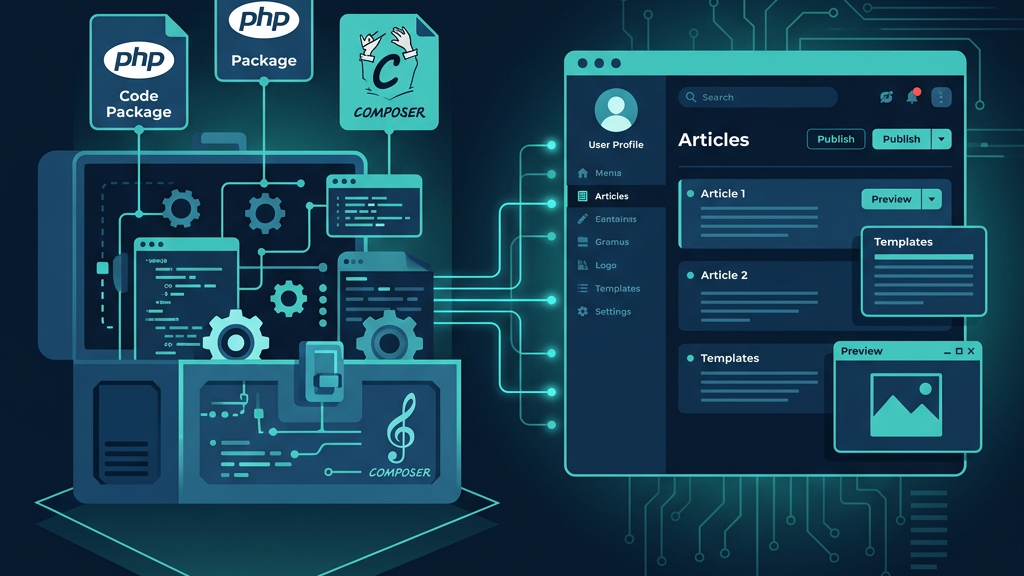


When we first started building extensions for Joomla, we quickly realized that the platform offers two distinct layers of technology: the Joomla Framework and the Joomla CMS. Both are powerful, but they serve different purposes. In this article we walk through the anatomy of each layer, compare them side by side, and help you decide which one fits your next project.
The Joomla Framework is a collection of independent PHP packages that provide low‑level services such as database access, HTTP handling, console commands, and configuration management. Each package lives in its own repository on GitHub joomla‑framework and can be installed via Composer. Because the packages are decoupled, you can use them to build anything from a simple CLI script to a full‑stack web application without pulling in the entire CMS.
In practice the framework acts like a toolbox for developers who want a solid, battle‑tested foundation while retaining full control over the application architecture. It is language‑agnostic in the sense that it does not enforce a particular front‑end, but it does assume a PHP environment and follows PSR‑4 autoloading standards.
The Joomla CMS is the content‑management system that most people recognize when they hear “Joomla.” It bundles the framework packages together with a full set of features: article management, menu handling, user authentication, extensions, and a templating engine. The CMS is delivered as a single installable package that can be deployed on any standard LAMP stack.
While the CMS relies on the same underlying code as the framework, it adds a layer of conventions and UI components that make it easy for non‑technical users to create and manage websites. If you need a ready‑made back‑end, multilingual support, and a large ecosystem of extensions, the CMS is usually the quickest path to a functional site.
| Aspect | Joomla Framework | Joomla CMS |
|---|---|---|
| Purpose | Provides reusable PHP libraries for building custom applications. | Delivers a complete website platform with UI, routing, and extensions. |
| Installation | Composer‑based, individual packages can be added as needed. | Single package installation via web installer or CLI. |
| Learning Curve | Requires knowledge of PHP, Composer, and the individual packages. | Lower for content editors; developers still need to understand MVC. |
| Flexibility | High – you can mix and match packages, replace parts, or use them outside Joomla. | Moderate – the CMS dictates the overall structure. |
| Performance | Potentially lighter because you load only what you need. | Heavier due to the full stack, but still well‑optimized. |
| Use Cases | Micro‑services, API back‑ends, custom admin tools, CLI utilities. | Corporate sites, blogs, e‑commerce, community portals. |
The joomla/database package abstracts PDO and offers a fluent query builder. It supports multiple drivers (MySQL, PostgreSQL, SQLite) and integrates with Joomla’s event system, allowing you to hook into query execution without touching core code.
The joomla/http package handles client‑side requests, server‑side responses, and provides utilities for cookie management, redirects, and header manipulation. It follows PSR‑7 standards, making it compatible with many modern middleware stacks.
The joomla/application package supplies the base class for both web and console applications. It manages the lifecycle, input handling, and error handling, giving you a consistent entry point for any PHP script.
With joomla/console you can create command‑line tools that integrate seamlessly with the framework’s configuration and logging facilities. This is especially handy for scheduled jobs, data migrations, or custom deployment scripts.
The joomla/registry package offers a flexible key‑value store that can be persisted to JSON, INI, or XML. It powers configuration handling across the framework and the CMS, and it supports dot‑notation for nested values.
We reach for the Joomla Framework whenever the project does not need the full CMS stack. Typical scenarios include:
Because the framework is Composer‑driven, we can keep the dependency footprint small and upgrade individual packages without touching the rest of the system. This modularity also makes it easier to write automated tests, as each package can be mocked or stubbed independently.
We choose the Joomla CMS when we need a ready‑made content administration interface, multilingual support, or a large catalog of extensions. Typical use cases are:
In these situations the CMS’s built‑in MVC architecture, templating system, and plugin events give us a solid foundation that can be extended with custom components, modules, or plugins. The Joomla development guide provides step‑by‑step instructions for creating such extensions.
Yes. The framework packages are already bundled inside the CMS, so any custom extension you write can directly tap into them. For example, a component may use the joomla/database package for complex queries while still rendering through the CMS’s view layer. This hybrid approach lets us enjoy the flexibility of the framework without sacrificing the convenience of the CMS’s UI.
When we need to go beyond the CMS’s scope—say, to expose a public API—we often create a separate Composer project that pulls in the same framework packages. The API can then share the same database connection and authentication logic as the main site, ensuring consistency across both front‑ends.
Getting up and running with the Joomla Framework is straightforward. Follow these steps:
composer require joomla/database joomla/http joomla/application joomla/console joomla/registry.index.php that boots the Application class and registers the needed services.Because the framework follows modern PHP standards, you can also integrate it with other libraries such as Symfony’s HttpFoundation or Laravel’s Eloquent, provided you respect the PSR‑4 autoloading rules.
Joomla is both. The core CMS is built on top of the Joomla Framework, which can be used independently. Think of the framework as the foundation and the CMS as the house that sits on it.
When we talk about “the best framework for Joomla,” we usually mean the official Joomla Framework because it is tightly aligned with the CMS’s architecture and receives regular updates. Third‑party options like Joomlatools Framework exist, but they are built on top of the official packages.
Yes. Since the packages are Composer‑compatible and follow PSR standards, you can require them in any modern PHP project, including Laravel and Symfony. Just be mindful of potential name collisions and configuration differences.
Absolutely. The framework receives regular security patches and feature updates. You can track the release schedule on the GitHub joomla‑framework page, and the community actively contributes to its evolution.
Whether you are building a lightweight API, a custom admin tool, or a full‑featured website, understanding the distinction between the Joomla Framework and the Joomla CMS helps us make smarter architectural decisions. By using the framework’s modularity when appropriate and the CMS’s out‑of‑the‑box capabilities when needed, we can deliver solutions that are both performant and maintainable.
For more background, read our what Joomla is overview, explore why the Joomla CMS is still relevant, or start building with our component creator tools and module generator.