Physical Address
304 North Cardinal St.
Dorchester Center, MA 02124
Physical Address
304 North Cardinal St.
Dorchester Center, MA 02124

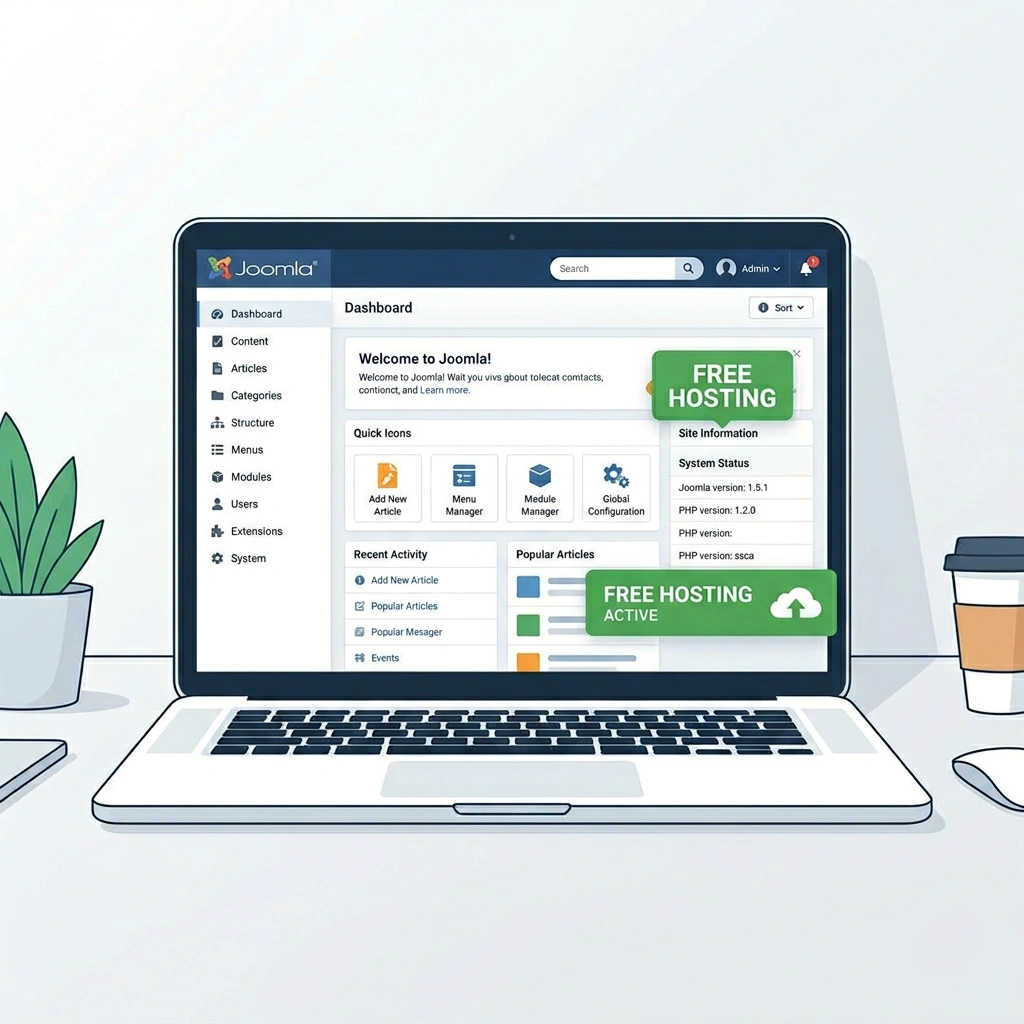


Free Joomla hosting is an attractive proposition for anyone who wants to launch a site without spending a dime. The idea of a completely cost‑free environment can be especially tempting for hobbyists, students, or small businesses testing the waters. In reality, “free” often comes with hidden limitations that can affect performance, security, and long‑term growth. In this article we explore what free joomla hosting actually provides, weigh its pros and cons, and help you decide whether it is a viable option for your project.
Free hosting plans usually include a basic control panel, a limited amount of disk space, and a modest bandwidth allowance. You can expect to install Joomla through a one‑click installer or manually upload the files via FTP. Most providers also offer a sub‑domain (e.g., yoursite.freehost.com) instead of a custom domain, and they may place a small banner or advertisement on your pages.
The PHP version supported on free tiers can lag behind the latest releases, which may restrict the extensions you can use. Database access is typically limited to a single MySQL database with a small size cap, often 1 GB or less. Email accounts are rarely included, and SSL certificates may be shared or unavailable without an upgrade.
Despite these constraints, many free hosts allow you to experiment with Joomla’s core features, install popular templates, and test extensions in a real‑world environment. The key is to understand precisely what is included before you commit any development effort.
A handful of providers have carved out a niche in the Joomla community by offering free plans that are explicitly marketed for CMS use. AwardSpace provides a free tier with 1 GB of storage, 5 GB of monthly traffic, and a one‑click Joomla installer. CloudAccess.net offers a “Free Joomla Hosting” option that integrates directly with the Joomla Extension Directory, making it easy to add extensions.
ZettaHost includes a free plan with 500 MB of space and limited bandwidth, while InfinityFree advertises “unlimited” bandwidth but enforces strict file size limits and a no‑SQL‑root policy. Finally, 000webhost supplies a free package with 300 MB of storage and a 3 GB monthly bandwidth cap, plus a custom sub‑domain.
Each of these providers has its own set of quirks—some display ads, others restrict certain PHP functions, and a few impose daily usage limits. By reviewing their documentation and community forums, we can gauge how well they support Joomla’s requirements.
When a host advertises a free plan, the cost is typically offset by other revenue streams. Advertisements placed on your site are a common method, and many providers also monetize through upselling premium features. The “free” label may also imply a lower priority for server resources, meaning your site could be placed on a shared server with many other users.
Service Level Agreements (SLAs) are rarely offered for free tiers, so uptime guarantees are vague at best. Backups may be performed infrequently, and you might have to manage restoration yourself. In short, “free” often translates to limited control, reduced performance, and a reliance on the host’s goodwill.
It is also worth noting that some providers discontinue free plans without much notice. If you have built a site on a free host and the service shuts down, you could lose your content unless you have maintained regular backups. We recommend always keeping a local copy of your Joomla files and database export.
For newcomers to Joomla, the absence of any upfront cost lowers the barrier to entry dramatically. We can spin up a site, explore the Joomla admin interface, and test extensions without worrying about a monthly invoice. This financial safety net encourages experimentation and helps us decide whether Joomla is the right platform before investing in a paid solution.
If you are just getting started with the CMS, our guide on what Joomla is provides a solid foundation before you choose any hosting plan. Understanding the platform’s strengths helps you make an informed decision about whether free hosting will meet your needs.
The zero‑cost entry point also makes Joomla accessible to non‑profit organizations, community groups, and educational projects that operate on tight budgets. For these use cases, even the limited resources of a free plan can be sufficient to establish an online presence.
A free Joomla host serves as an ideal sandbox for learning. We can install new templates, try out third‑party extensions, and practice site migrations without risking a live production environment. Because the stakes are low, we are more willing to experiment with advanced configurations, such as custom modules or complex menu structures, which can accelerate our mastery of Joomla.
Developers who need to test Joomla component development or plugin hooks can benefit from a disposable environment that costs nothing to provision. This is especially valuable during the prototyping phase when configurations change frequently.
For agencies that build Joomla sites for clients, a free staging host can serve as a quick demo environment. While not suitable for production use, it allows stakeholders to preview layouts and functionality before committing to a paid plan.
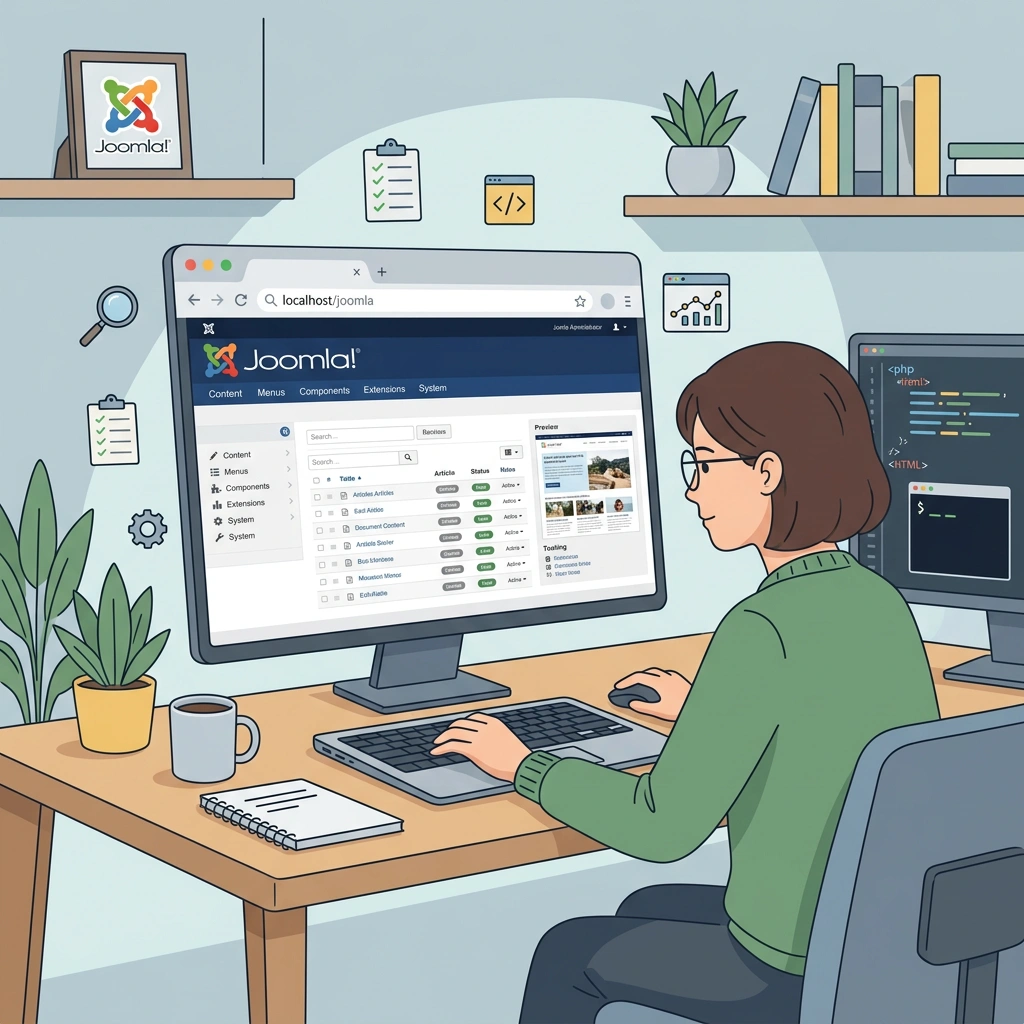
Most free hosts provide one‑click installers or pre‑configured Joomla images, allowing us to launch a site in minutes. The onboarding process is streamlined, and there is no lengthy contract to sign. This speed is valuable when we need a temporary site for a demo, a short‑term campaign, or a client proof‑of‑concept.
The lack of commitment also means we can try multiple providers simultaneously. If one host does not meet our needs, we can migrate to another without financial penalties. This flexibility is a significant advantage during the evaluation phase.
For a step‑by‑step walkthrough of getting Joomla up and running, see our complete installation guide, which covers both free and paid hosting environments.
Free servers often host dozens or hundreds of sites on a single physical machine. This oversubscription can lead to slower page load times, especially during peak traffic periods. Joomla’s dynamic content generation relies on PHP and database queries, which may be throttled on a low‑priority server, resulting in a sub‑optimal user experience.
Slow loading times directly impact user engagement. Visitors who wait more than three seconds for a page to load are significantly more likely to leave. For sites that depend on retaining visitors, this performance penalty alone can outweigh the cost savings of free hosting.
If performance matters to your project, our article on Joomla performance optimization covers server‑level and application‑level techniques. However, many of these optimizations require server access that free hosts do not provide.

The disk space allocated on free plans is typically modest—ranging from 300 MB to 1 GB. Large media files, high‑resolution images, or extensive article archives can quickly exhaust this quota. Bandwidth caps, such as 3 GB to 5 GB per month, may also be insufficient for sites that receive regular traffic, causing the site to become unavailable once the limit is reached.
These restrictions become particularly problematic for Joomla sites that use image‑heavy templates or serve downloadable content. A single Joomla installation with a few extensions and a basic template can easily consume 200–400 MB, leaving minimal room for actual content.
If you plan to use media extensively, optimizing file sizes before upload is essential. Our guide on Joomla image optimization explains how to compress images without losing visual quality, which can help stretch limited storage further.
Free hosts often lack the security infrastructure found in paid services. Automated malware scanning, firewalls, and intrusion detection may be absent or limited. Additionally, shared hosting environments increase the risk that a compromised neighboring site could affect yours. Without dedicated security updates or a support team to address vulnerabilities, we must take extra precautions.
Installing security extensions and following a security audit checklist become even more important on free hosting. You should also enable two‑factor authentication on your Joomla admin panel as an additional layer of protection.
The absence of SSL certificates on many free plans is another concern. Without HTTPS, data transmitted between visitors and your site is unencrypted, which browsers now flag as insecure. Our SSL setup guide covers the technical details, though implementation depends on what your host allows.
When a technical issue arises—whether it is a PHP error, a database connection problem, or a server outage—free hosts typically provide only community forum support or a basic ticket system with long response times. The absence of live chat or phone support can leave us stranded, especially if we lack deep server administration knowledge.
Response times on free‑tier support channels can range from 24 hours to several days. For a personal blog, this delay may be tolerable. For a site that serves clients or generates revenue, extended downtime is unacceptable.
Self‑reliance becomes a necessity on free hosting. We need to be comfortable troubleshooting common Joomla errors, managing database backups, and resolving PHP compatibility issues on our own. The Joomla community forums and documentation are valuable resources, but they are no substitute for dedicated technical support.
The following table highlights the key differences between typical free and paid Joomla hosting plans. Use it as a quick reference when evaluating your options.
| Feature | Free Joomla Hosting | Paid Joomla Hosting |
|---|---|---|
| Price | $0 / month | $3–$10 / month |
| Disk Space | 300 MB–1 GB | 10 GB–100 GB |
| Bandwidth | 3 GB–5 GB / month | Unlimited or 100 GB+ |
| SSL Certificate | Shared or none | Free Let’s Encrypt or paid SSL |
| Custom Domain | Sub‑domain only | Full domain support |
| Email Accounts | None or 1–2 | 5–20+ accounts |
| PHP Version | Often outdated | Latest stable version |
| MySQL Databases | 1 (≤1 GB) | Multiple, larger size |
| Uptime Guarantee | No formal SLA | 99.9%+ SLA |
| Backups | Manual or infrequent | Automated daily backups |
| Support | Community forums | 24/7 live chat, ticketing |
| Ads on Site | Often required | None |
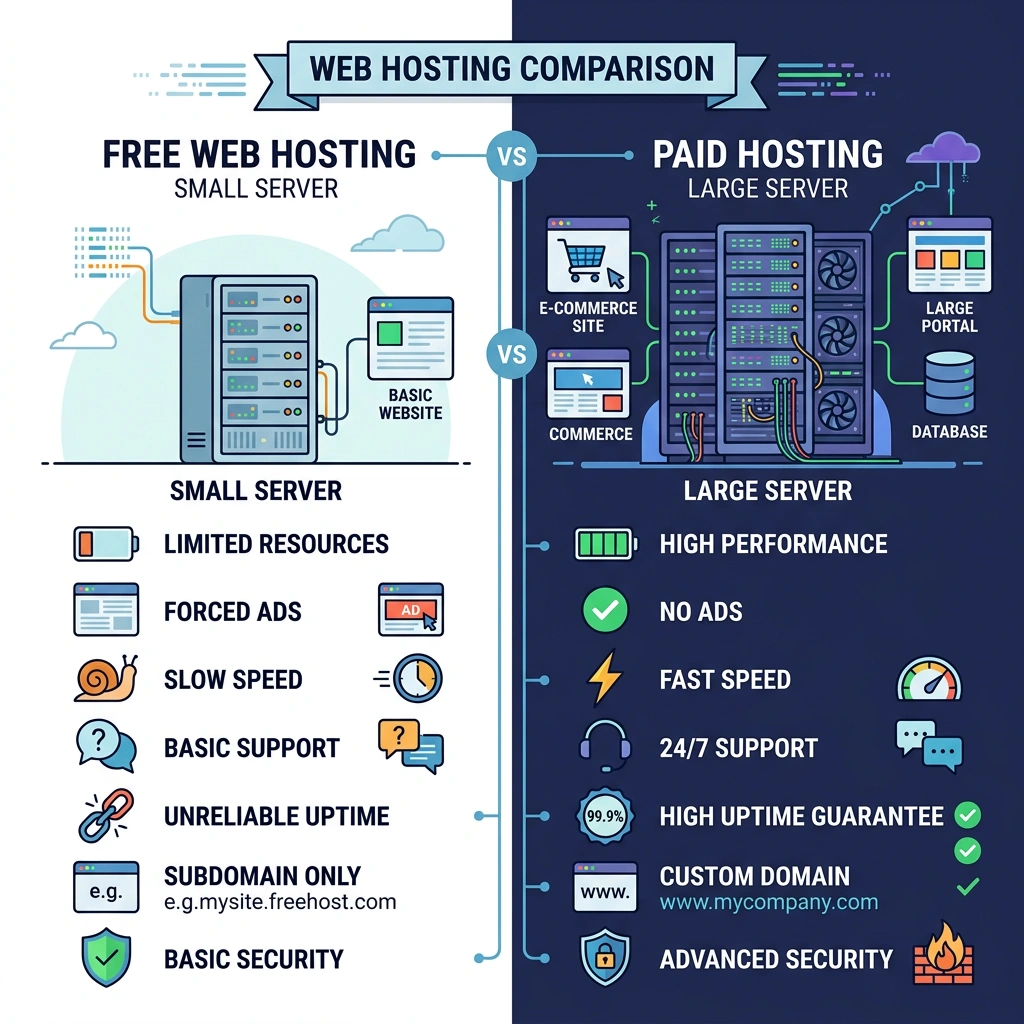
The table shows a stark contrast in resources, reliability, and support. While a free plan can be sufficient for a hobby site, a paid plan provides the stability and features needed for professional or revenue‑generating projects. For a deeper dive into hosting options, see our guide on the best Joomla hosting providers.
If we are showcasing a personal portfolio, a hobby blog, or a small community site, the limited resources of a free plan may be adequate. The primary goal is to present content rather than to handle high traffic or complex e‑commerce transactions. In such cases, the cost savings outweigh the performance trade‑offs.
A free‑hosted Joomla portfolio can serve as a proof of concept before investing in a custom domain and paid hosting. It allows us to build out the site structure, test navigation, and gather feedback from peers without financial pressure.
For personal projects where uptime is not mission‑critical, the occasional slowdown or brief outage is a minor inconvenience rather than a business risk. The important thing is to keep regular backups in case the free provider changes its terms or discontinues the service.
Free hosting is an excellent choice for staging environments where we test new Joomla extensions, theme updates, or configuration changes before deploying them to a live site. Because the staging site is not customer‑facing, occasional downtime or slower performance is acceptable. It also allows us to keep the production environment clean and stable.
Developers building custom components can use a free host to test their code in a real server environment without provisioning a local development stack. While local environments like XAMPP or Docker are more flexible, a remote free host provides a closer approximation of production conditions.
For teams that need multiple staging instances—one per developer or per feature branch—free hosts offer a no‑cost way to spin up disposable environments. Just remember that performance on free hosts may not accurately reflect production behavior.
For beginners learning Joomla, a free host provides a risk‑free playground. We can experiment with menu creation, module placement, and template customization without the pressure of maintaining a professional site. The experience gained here can later be transferred to a paid hosting environment when the project scales.
Online tutorials and courses often recommend starting with a free host so students can follow along without additional expenses. This approach is particularly common in Joomla community workshops and certification programs.
Once you are comfortable with the basics, transitioning to paid hosting is straightforward. Most paid providers offer migration tools or support to help you move your site with minimal disruption.
A business website or online store requires consistent uptime, fast load times, and security—features that free hosts rarely guarantee. Downtime can translate directly into lost revenue, and the presence of ads can undermine brand credibility. For e‑commerce, secure payment processing and compliance with data protection standards are essential.
Customers expect a professional experience when interacting with a business online. A sub‑domain URL (e.g., yourbusiness.freehost.com) immediately signals a lack of investment in the brand. Combined with potential ad banners, this can erode trust before a visitor even engages with your content.
If you are running an online store with Joomla, the hosting requirements are significantly higher. Payment gateways require SSL, inventory management needs reliable database access, and customer data must be protected. Free hosting simply cannot meet these requirements.
If we anticipate rapid traffic growth, the bandwidth and storage limits of free plans will quickly become bottlenecks. Scaling up on a free host is often impossible without migrating to a paid service, which can involve downtime and data migration challenges. Planning for growth from the start helps avoid disruptive transitions.
Content‑heavy sites that publish regularly will outgrow free storage within months. A site publishing two or three articles per week with accompanying images can consume its entire 1 GB allocation in under three months.
The migration process itself introduces risk. Database exports can fail or produce incomplete backups, and DNS propagation during domain transfers can cause temporary accessibility issues. Starting on a paid host avoids this disruption entirely.
Search engine rankings are influenced by site speed, uptime, and security. Free hosting’s slower response times and potential downtime can negatively affect SEO performance. Moreover, the presence of ads or a sub‑domain can dilute brand signals. For sites that rely heavily on organic traffic, a reliable paid host is usually the smarter investment.
Google’s Core Web Vitals, which measure loading performance, interactivity, and visual stability, are difficult to pass on a resource‑constrained free server. Poor scores can result in lower rankings and reduced visibility in search results.
Additionally, free hosts often lack support for features like CDN integration and advanced caching, which are critical for delivering fast page loads globally. If SEO is a priority, investing in hosting that supports these optimizations is non‑negotiable.
When evaluating free Joomla hosts, we should prioritize providers that offer a one‑click Joomla installer, at least 500 MB of storage, and a reasonable bandwidth allowance of 5 GB per month or more. Support for the latest PHP version (8.1 or higher) and MySQL is crucial for compatibility with recent Joomla releases.
The ability to use a custom domain, even if it requires a manual DNS setup, adds professionalism. Look for providers that include at least a shared SSL certificate—this is increasingly important as browsers flag HTTP sites as insecure.
FTP access and phpMyAdmin are also important for managing files and databases directly. Without these tools, troubleshooting issues or performing manual backups becomes significantly harder.
Beware of hosts that force advertisements on every page, limit PHP functions (such as exec or shell_exec), or provide no SSL support. Extremely low storage (under 200 MB) or bandwidth (under 2 GB per month) can quickly become a problem.
Check for hidden fees—some “free” plans charge for additional features like backups, email accounts, or domain mapping. Read the terms of service carefully to understand what is included and what requires an upgrade.
User reviews and community feedback are valuable indicators. If a provider has a history of unexpected downtime, data loss, or poor communication, it is better to avoid them regardless of the price. The Joomla Community Forum and r/joomla on Reddit are good sources for candid hosting reviews.
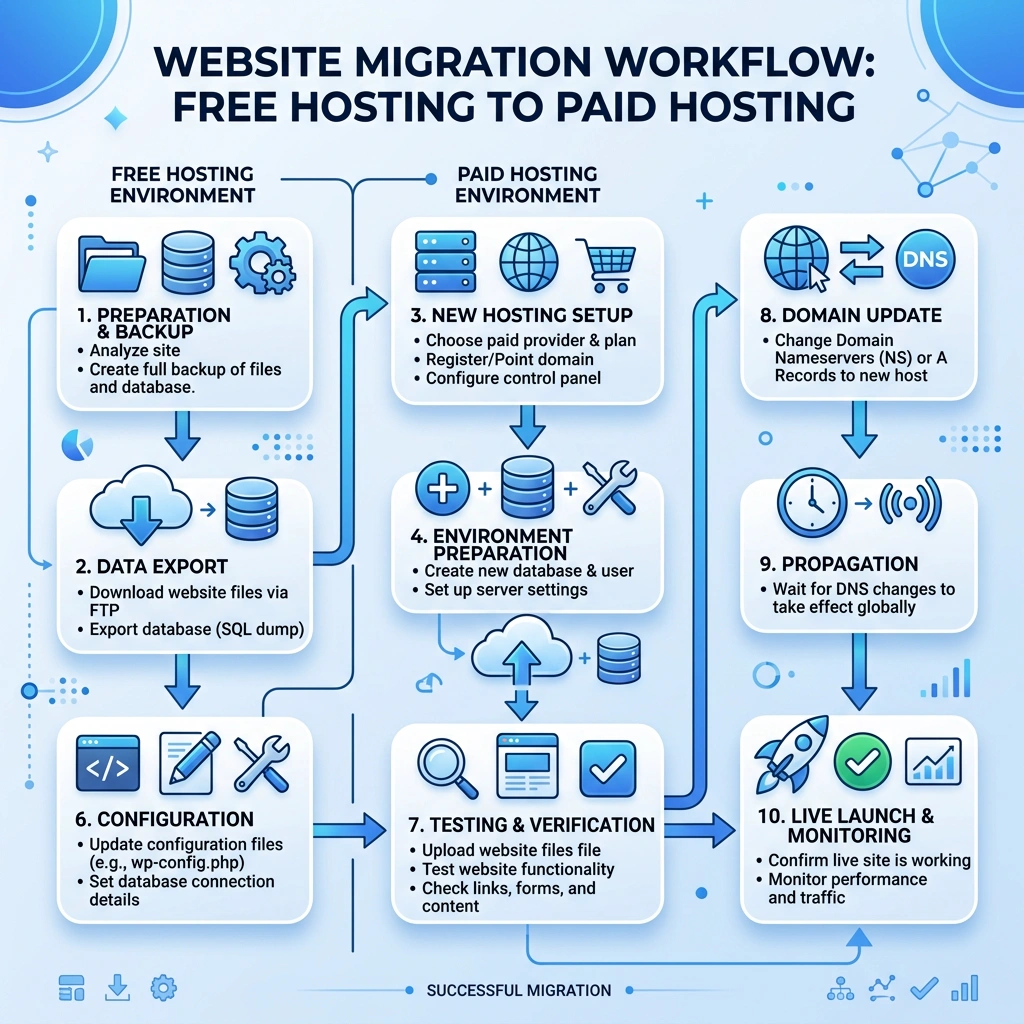
A smooth migration path is essential when choosing a free host. Look for providers that allow us to export our Joomla database and files without restrictions. Some providers, like CloudAccess.net, offer a direct upgrade to a paid plan that retains our data and configuration.
Documenting the migration steps early saves time and reduces the risk of data loss when we eventually outgrow the free tier. Keep regular backups using Joomla’s built‑in tools or extensions like Akeeba Backup, which can create complete site snapshots.
Before committing to a free host, verify that the provider does not lock your data or impose export restrictions. Full access to your files via FTP and your database via phpMyAdmin ensures you can migrate at any time.
Shared hosting plans from reputable companies often start at $2–$4 per month, providing significantly more resources than free tiers. These plans typically include unlimited bandwidth, SSD storage, free SSL, and a custom domain. Providers such as SiteGround, A2 Hosting, and Hostinger have Joomla‑optimized shared plans that balance cost and performance.
At this price point, you also get professional support, automated backups, and server‑level security features that free hosts cannot match. The marginal cost is often less than a cup of coffee per month, making it an easy justification for any project that goes beyond casual experimentation.
Many budget hosts also include website builders, staging environments, and one‑click Joomla installers, which streamline the setup process. The combination of low cost and rich features makes budget shared hosting the sweet spot for most Joomla users.
Some hosts specialize in Joomla and offer plans under $5 per month with features like auto‑updates, Joomla‑specific caching, and pre‑installed extensions. These plans are designed to deliver optimal performance for Joomla sites without requiring manual server configuration.
HostPapa and Bluehost provide Joomla‑ready environments with one‑click installers, enhanced security, and 24/7 support—all within a modest budget. SiteGround’s StartUp plan, while slightly above $5, includes their SuperCacher technology which significantly improves Joomla load times.
For a comprehensive comparison of Joomla‑friendly hosts, including performance benchmarks and feature breakdowns, see our detailed best Joomla hosting guide. We test and review providers regularly to ensure our recommendations remain current.
Free web hosting can be useful for learning, testing, or low‑traffic personal sites. However, the trade‑offs in performance, security, and support often make it unsuitable for business or SEO‑critical projects. If your site needs to generate revenue or attract organic search traffic, a low‑cost paid plan is a better investment.
Joomla itself is free and open‑source software, but you need a web server to run it. Several providers offer free Joomla hosting plans with limited resources. For production use, most site owners choose paid hosting that costs between $3 and $10 per month for adequate performance and support.
Common disadvantages include limited storage and bandwidth, slower page load times, lack of SSL certificates, minimal security measures, forced advertisements on your site, and reliance on community support rather than dedicated technical assistance. Free hosts may also discontinue service with little notice.
Most free hosts allow standard extensions, but restrictions on PHP functions, file size, or database access may prevent certain extensions from working correctly. Extensions that require higher PHP versions, extensive database usage, or cron job support are most likely to encounter compatibility issues on free hosting.
The migration process typically involves exporting your Joomla database via phpMyAdmin, downloading all site files via FTP, and then importing them into your new host’s control panel. Many paid hosts offer free migration assistance or automated tools like Akeeba Backup to simplify the transition. Plan for a few hours of downtime during the DNS propagation phase.
Yes. Factors such as slower loading speeds, downtime, lack of SSL, and the presence of ads can negatively impact SEO rankings. Google’s Core Web Vitals favor fast, stable, and secure sites. Using a reputable paid host with better performance and security is generally recommended for any site that depends on organic search traffic.