Physical Address
304 North Cardinal St.
Dorchester Center, MA 02124
Physical Address
304 North Cardinal St.
Dorchester Center, MA 02124




For the first time in its 23-year history, WordPress is losing market share. According to W3Techs data from early 2026, WordPress powers 60.2% of all CMS-driven websites — down 2.9% from its peak of 63.1% in late 2024. That might sound like a rounding error, but in an ecosystem of 1.9 billion websites, 2.9% represents millions of sites that chose something else.
Why? The reasons are as varied as the alternatives themselves. Some developers are frustrated by the Gutenberg block editor’s constant changes. Others want better performance out of the box. Ecommerce store owners are tired of plugin conflicts. And a new generation of developers simply prefers headless architectures and modern JavaScript frameworks over PHP templates.
We spent six weeks testing 12 WordPress alternatives — installing each one, building a real site, running performance benchmarks, testing SEO capabilities, and evaluating the migration path from WordPress. This isn’t a listicle based on screenshots and marketing pages. We actually used each platform.
Here’s what we found.
| Platform | Type | Best For | Starting Price | SEO Score* | Speed Score* | Learning Curve |
|---|---|---|---|---|---|---|
| Joomla 5 | Open-source CMS | Multilingual sites, complex permissions | Free (hosting needed) | 9/10 | 8/10 | Moderate |
| Drupal 11 | Open-source CMS | Enterprise, government, universities | Free (hosting needed) | 9/10 | 7/10 | Steep |
| Ghost | Headless CMS / Blog | Writers, newsletters, memberships | $9/mo (hosted) | 8/10 | 10/10 | Easy |
| Wix | Website builder | Small business, portfolios | $17/mo | 6/10 | 6/10 | Very easy |
| Squarespace | Website builder | Design-focused sites, restaurants | $16/mo | 7/10 | 7/10 | Easy |
| Webflow | Visual dev platform | Designers who code, agencies | $14/mo | 8/10 | 9/10 | Moderate |
| Strapi | Headless CMS | API-first projects, developers | Free (self-hosted) | N/A** | 9/10 | Steep |
| Shopify | Ecommerce platform | Online stores | $39/mo | 7/10 | 8/10 | Easy |
| Hugo | Static site generator | Blogs, documentation, developers | Free | 8/10 | 10/10 | Steep |
| Payload CMS | Headless CMS | TypeScript developers, custom apps | Free (self-hosted) | N/A** | 9/10 | Steep |
| Concrete CMS | Open-source CMS | Marketing teams, in-page editing | Free (self-hosted) | 7/10 | 7/10 | Moderate |
| Framer | Visual web builder | Landing pages, marketing sites | $5/mo | 7/10 | 9/10 | Easy |
*SEO Score based on built-in SEO tools, URL structure control, schema support, sitemap generation, and meta tag management. Speed Score based on default installation Lighthouse scores. **Headless CMS platforms are frontend-agnostic; SEO depends entirely on your frontend implementation.
Joomla 5 is the WordPress alternative that WordPress users are most likely to underestimate. It’s been around since 2005, powers over 2 million active websites, and went through a massive modernization with its 4.x and 5.x releases. The new admin interface is clean, the codebase runs on modern PHP 8.2+, and it comes with features that WordPress only gets through third-party plugins.
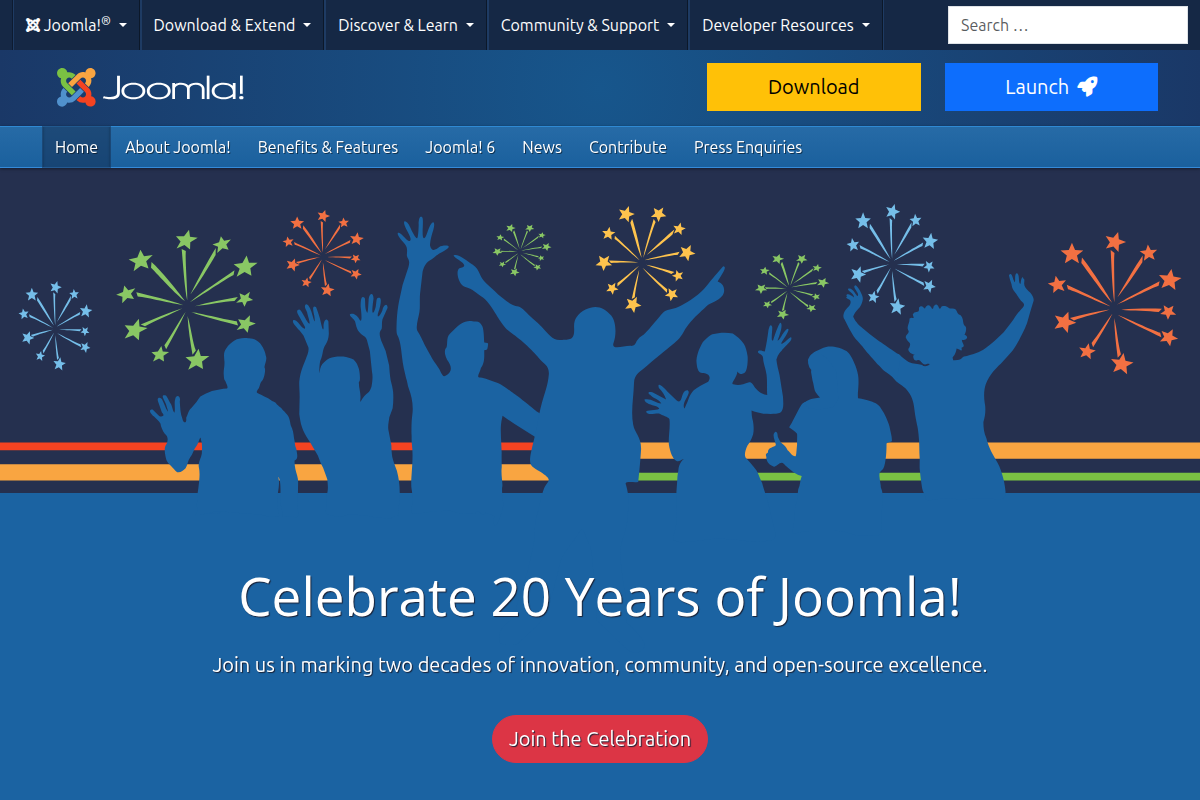
The standout feature is built-in multilingual support. Where WordPress requires WPML ($99/year) or Polylang plus hours of configuration, Joomla handles multiple languages natively. You install language packs, assign content associations, and you’re done. For our test site — a five-language European business directory — Joomla multilingual support saved us an estimated 15-20 hours compared to the equivalent WordPress setup.
The Access Control Level (ACL) system is equally impressive. You can define granular user groups with specific viewing, editing, and publishing permissions per section of your site. This makes Joomla ideal for intranets, membership sites, educational platforms, and any project where “who can see what” matters. WordPress can do this with plugins like Members or User Role Editor, but Joomla’s implementation is core and more battle-tested.
If you’re coming from WordPress and curious about Joomla, we’ve written a detailed Joomla vs WordPress comparison that covers every angle.
Free and open-source. You’ll pay for hosting ($5-30/month depending on provider — check our best Joomla hosting picks), a domain, and potentially premium templates or extensions. Total cost for a professional site: $100-500/year, which is comparable to or less than a plugin-heavy WordPress installation.
Multilingual websites, corporate intranets, educational platforms, government sites, membership portals, and any project where user permissions and content organization matter more than having 60,000 plugins to choose from.
Moderate. There’s no one-click migration tool, but Joomla.org provides migration documentation, and tools like FG Joomla to WordPress (used in reverse) or manual CSV import handle content migration. Budget 2-5 days for a site with 50-200 pages. The mental model shift — learning Joomla’s article/category/menu architecture — takes longer than the actual data migration.
If Joomla is the power user’s CMS, Drupal is the enterprise architect’s CMS. Drupal 11, released in mid-2025, continues the platform’s evolution into a serious content management framework. The White House, Tesla, NBC, and dozens of major universities run on Drupal for a reason: when you need absolute control over content modeling, workflows, and security, nothing in the open-source world matches it.
Drupal’s content modeling system is its defining feature. You define custom content types, fields, taxonomies, and relationships through a GUI or configuration files. Need a “Research Paper” content type with fields for abstract, authors (entity reference to People), related publications (entity reference), funding sources (taxonomy), and a PDF attachment? That’s 10 minutes of clicking in Drupal, no code required.
The trade-off is complexity. Drupal’s learning curve is genuinely steep. Even experienced developers need time to internalize concepts like entities, field storage, Views, display modes, and the configuration management system. For our Joomla vs Drupal comparison, the Joomla site was production-ready in 3 days; the equivalent Drupal build took 7.
Free and open-source. Hosting for Drupal tends to be pricier because it’s more resource-intensive — expect $20-100/month for managed Drupal hosting (Pantheon, Acquia, Platform.sh). Enterprise Drupal projects easily run $10K-100K+ in development costs.
Large organizations with complex content requirements, government sites needing WCAG compliance, universities, media companies with thousands of content types, and any project where content modeling and editorial workflow are critical.
Hard. The Migrate API is powerful but requires developer knowledge. Content mapping between WordPress’s simpler post/page model and Drupal’s entity system takes planning. Budget 1-4 weeks for a medium-complexity site. Drupal.org has comprehensive migration documentation.
Ghost is what WordPress would look like if it were rebuilt today by people who only cared about writing and publishing. It’s a Node.js-based platform that’s laser-focused on content creation, membership sites, and newsletters. No plugin marketplace. No theme customizer with 200 options. Just a beautiful editor and a fast website.
The editor is the star. It’s a clean, card-based system where you write in Markdown (or rich text), embed dynamic content cards (email CTAs, product recommendations, bookmark cards, galleries), and preview exactly what readers will see. It’s genuinely pleasant to write in — something you can’t say about Gutenberg or Classic Editor without lying.
Ghost’s built-in membership and newsletter system is the real business case. You can offer free and paid tiers, gate content behind subscriptions, send newsletters directly from your Ghost dashboard (powered by Mailgun), and track member growth — all without Mailchimp, ConvertKit, or MemberPress. For a solo creator or small publication, this replaces $50-200/month in WordPress plugins.
Self-hosted: free (Node.js hosting needed, $5-20/month). Ghost(Pro) managed hosting: $9/month (Starter), $25/month (Creator), $50/month (Team), $199/month (Business). The managed hosting includes CDN, SSL, backups, and email sending.
Bloggers, journalists, newsletter creators, independent publishers, and anyone building a content-first business with memberships. If you’re running a magazine, Substack alternative, or paid newsletter, Ghost is the strongest option on this list.
Easy. Ghost has an official WordPress migration plugin that exports posts, pages, images, and tags. We migrated a 300-post WordPress blog in under 30 minutes. The main work is adjusting your theme and rebuilding any custom functionality you had through plugins.
Wix is the “good enough” WordPress alternative for people who never wanted to learn about hosting, caching, security updates, or PHP in the first place. It’s a fully hosted, drag-and-drop website builder with 900+ templates, an AI site generator, built-in ecommerce, and more features than most small businesses will ever use.
In 2026, Wix is a genuinely capable platform. The new Wix Studio (replacing Editor X) offers responsive design controls that rival Webflow. The AI tools can generate entire page layouts, write copy, and create logos. And the App Market has grown to include serious business tools — booking systems, restaurants, fitness studios, and event management.
The catch is what you give up. You’re locked into Wix’s ecosystem. You can’t export your site to another platform (not really — the export tools are minimal). SEO has improved significantly but still lags behind self-hosted solutions. And once you outgrow Wix’s capabilities, there’s no gradual migration path — you rebuild from scratch.
Free tier (with Wix branding). Light: $17/month. Core: $29/month. Business: $36/month. Business Elite: $159/month. Ecommerce plans start at $29/month. All prices are annual billing; monthly billing is 20-30% higher.
Local businesses, freelancers, restaurants, personal portfolios, and anyone who values simplicity over control. If you’re a plumber who needs a website this weekend and never wants to think about it again, Wix is your best bet.
Moderate. No automated migration. You’ll manually recreate pages, re-upload images, and rebuild forms. Blog posts can be imported via RSS. Budget 1-3 days for a small site. The harder part is accepting you’ll lose any custom functionality that relied on WordPress plugins.
Squarespace is the website builder you choose when design matters more than anything else. Every Squarespace template looks like it was designed by a professional agency (because it was), and the platform makes it nearly impossible to create an ugly website. That’s both its greatest strength and its most notable limitation.
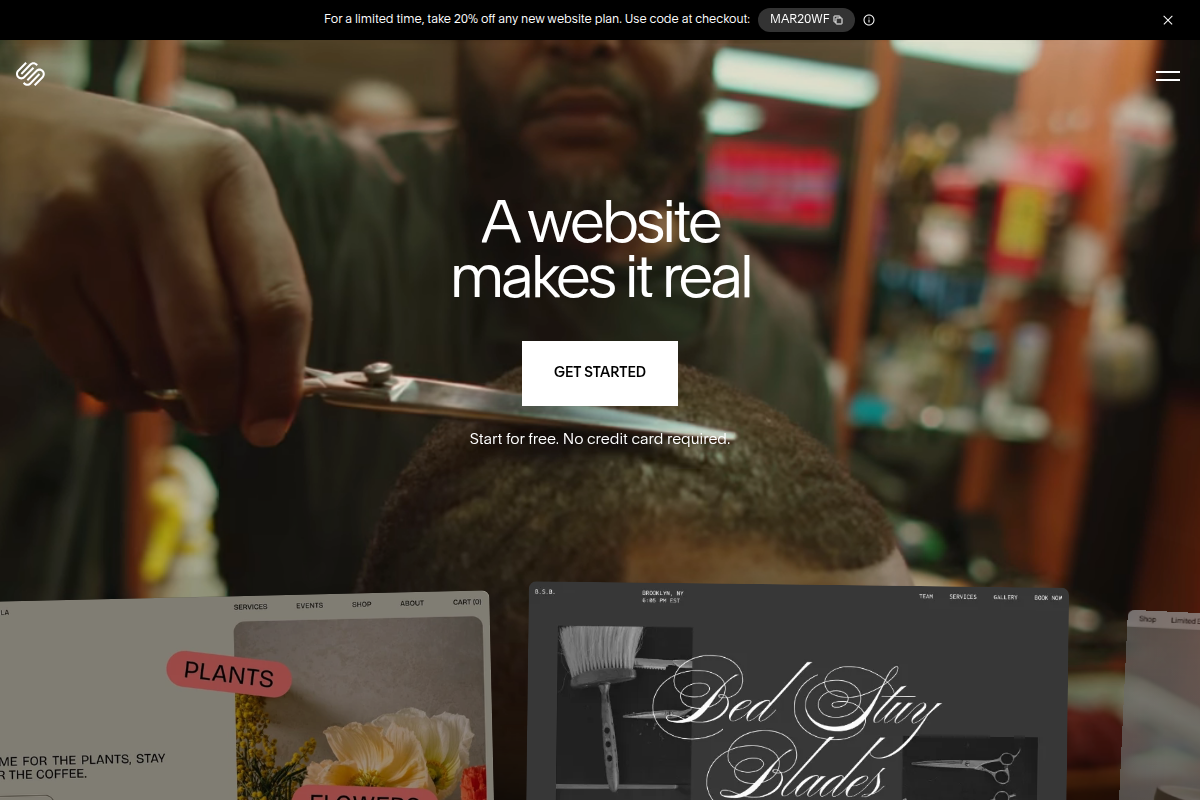
The Fluid Engine, introduced in late 2023 and refined through 2025, replaced the older section-based editor with a true drag-and-drop grid system. You can now place elements anywhere on the page with pixel precision, create overlapping layouts, and build responsive designs that adapt across breakpoints. It’s a massive improvement that closed the gap with Webflow for many use cases.
Squarespace also handles ecommerce well for small to medium stores. The built-in commerce features include inventory management, abandoned cart recovery, subscription products, and integration with major shipping carriers. It won’t replace Shopify for a 10,000-SKU operation, but for a boutique selling 50-200 products, it’s more than capable.
Personal: $16/month. Business: $33/month. Commerce Basic: $36/month. Commerce Advanced: $65/month. All prices are annual billing. Free custom domain included for the first year.
Photographers, artists, restaurants, small businesses that prioritize aesthetics, portfolio sites, wedding websites, and anyone who wants a beautiful site without hiring a designer.
Easy to Moderate. Squarespace has a built-in WordPress import tool that handles posts, pages, images, and comments. Custom post types and plugin-generated content won’t transfer. Budget 1-2 days for a blog or small business site.
Webflow sits in a unique space: it’s a visual development platform that generates clean, production-ready HTML, CSS, and JavaScript. Think of it as “Photoshop for websites” — you design visually but with the full power of the CSS specification at your fingertips. No themes, no templates (unless you want them), no constraints.
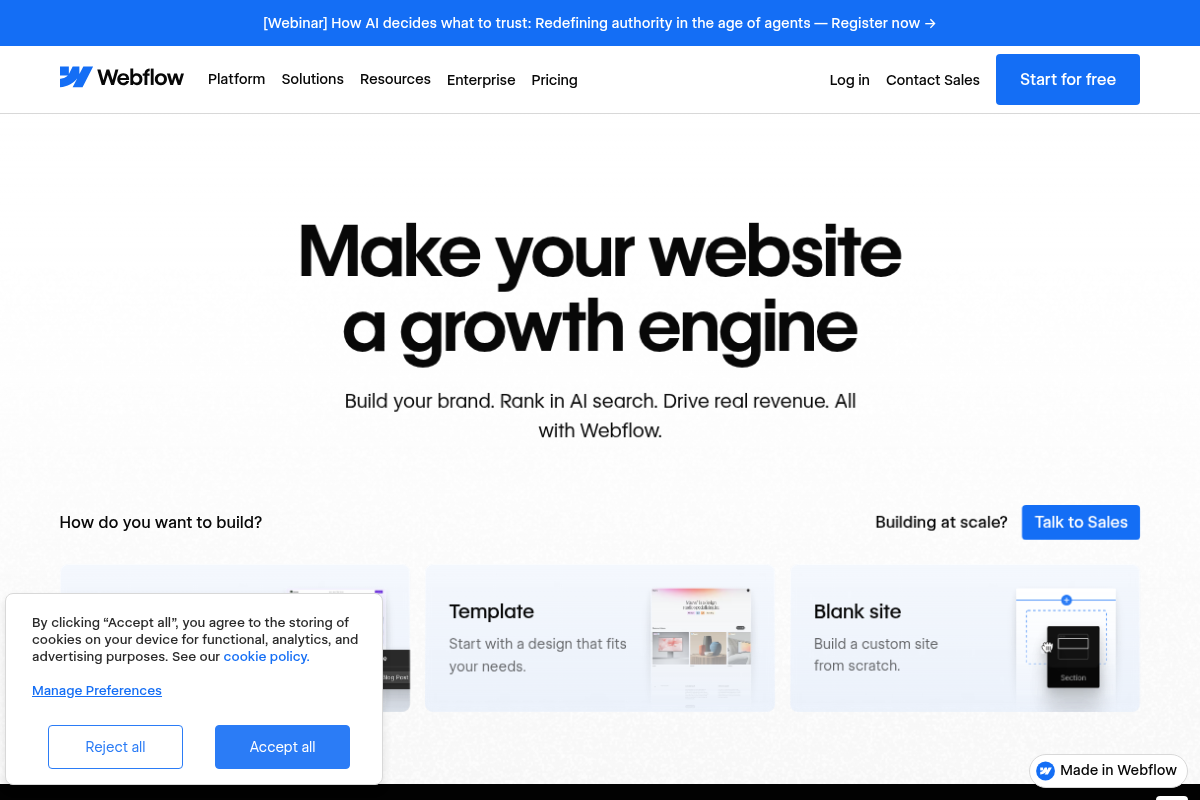
For designers and agencies, Webflow is transformative. You can build complex, custom designs without writing code, add CMS-driven dynamic content, create interactions and animations that would normally require a JavaScript developer, and hand off a live, working website instead of static mockups. The learning curve is real — you need to understand CSS concepts like flexbox, grid, and positioning — but the payoff is enormous.
The CMS is capable but limited compared to traditional platforms. You get collections (like custom post types), reference fields, multi-image fields, and rich text. But you’re capped at 10,000 CMS items on the most expensive plan, and complex relational data modeling isn’t Webflow’s strength.
Starter: Free (webflow.io subdomain, 2 pages). Basic: $14/month. CMS: $23/month. Business: $39/month. Enterprise: custom pricing. Workspace plans for teams: $19-49/seat/month.
Design agencies, freelance designers, marketing teams building campaign sites, SaaS companies, and anyone who needs pixel-perfect custom design without a developer. Not ideal for blogs with thousands of posts or complex web applications.
Hard. There’s no automated migration path. You’ll redesign the site in Webflow’s visual editor (which is kind of the point — you’re choosing Webflow for the design capabilities). Content can be imported via CSV into CMS collections. Budget 1-4 weeks depending on site complexity.
Strapi is a headless CMS — meaning it manages your content and delivers it through APIs, but it doesn’t generate any frontend. You build your frontend with whatever technology you prefer: React, Vue, Next.js, Nuxt, Svelte, Astro, or even a mobile app. Strapi is the content backend.
This architecture is increasingly popular in 2026 because it decouples content management from content presentation. Your marketing team uses Strapi’s admin panel to create and edit content. Your developers consume that content through REST or GraphQL APIs and render it however they want. Need to display the same content on a website, mobile app, and digital signage? One Strapi backend serves them all.
Strapi v5, released in late 2025, brought significant improvements: a new document service API, simplified content types, better TypeScript support, and improved performance. The plugin ecosystem has matured with options for SEO, media management, email, and internationalization.
Community Edition: Free, self-hosted. Strapi Cloud (managed): starts at $29/month. Enterprise: custom pricing (SSO, audit logs, review workflows). The self-hosted option is genuinely free with no feature limitations that matter for most projects.
Developer teams building modern web applications, companies that need to serve content to multiple platforms (web, mobile, IoT), JAMstack enthusiasts, and organizations with existing frontend development capability. Not for non-technical users.
Hard. Conceptually different architecture. You’ll need to: model your content types in Strapi, write a migration script (WordPress REST API → Strapi API), and build an entirely new frontend. Budget 2-8 weeks depending on complexity and frontend choice.
If you’re switching from WordPress + WooCommerce specifically because of ecommerce pain points, Shopify is the most obvious alternative. It’s the world’s largest dedicated ecommerce platform, powering over 4.7 million online stores. Everything about Shopify is optimized for selling products online.
Where WooCommerce requires you to assemble an ecommerce stack from plugins (payment gateway, shipping calculator, inventory management, abandoned cart recovery, product reviews, order management), Shopify includes all of this out of the box. The admin panel is purpose-built for managing orders, tracking inventory across multiple locations, and running promotions. It just works — and for many store owners, that reliability is worth the monthly fee.
The app ecosystem is massive (8,000+ apps), and Shopify’s Liquid templating language, while proprietary, is well-documented and relatively easy to learn. Shopify Plus ($2,300/month) serves enterprise clients like Allbirds, Gymshark, and Heinz. For a comparison of open-source ecommerce approaches, see our article on Joomla ecommerce capabilities.
Basic: $39/month. Shopify: $105/month. Advanced: $399/month. Plus: $2,300/month. All plans include hosting, SSL, and unlimited products. Transaction fees (unless using Shopify Payments): 2%, 1%, 0.5%, and 0.15% respectively.
Dedicated online stores, dropshipping businesses, multi-channel retailers, and anyone who wants ecommerce to “just work” without managing hosting, security, or plugin compatibility. If you’re selling physical or digital products and ecommerce is your core business, Shopify is hard to beat.
Moderate. Shopify has a built-in Store Importer that handles products, customers, and orders from WooCommerce. Blog posts need manual migration. The hardest part is rebuilding custom WooCommerce functionality (custom checkout flows, complex shipping rules, product configurators) in Shopify’s ecosystem. Budget 1-3 weeks for a medium store.
Hugo is a static site generator written in Go. It takes your content (written in Markdown files), applies templates, and generates a complete static HTML website. No database. No server-side processing. No PHP. Just HTML, CSS, and JavaScript files that can be served from any CDN for near-zero latency worldwide.
The speed is not an exaggeration. Hugo can build a 10,000-page site in under 10 seconds. The resulting static files load in milliseconds. Our test site — a 200-page documentation site — scored a perfect 100/100 on every Lighthouse metric. You simply cannot build a faster website with any other platform on this list.
But Hugo is firmly a developer tool. There’s no admin panel, no WYSIWYG editor, no drag-and-drop builder. You write content in Markdown files, organize them in directories, and run a build command. Themes exist but customizing them requires learning Hugo’s Go-based templating language, which has a learning curve even for experienced developers.
Free and open-source. Hosting is free on Netlify, Vercel, or Cloudflare Pages for most sites. You might pay for a CMS layer like Decap CMS, Forestry (now Tina CMS), or CloudCannon to give non-technical users an editing interface ($0-49/month).
Developer blogs, documentation sites, marketing sites maintained by technical teams, and any project where performance and security are paramount and you have developers willing to maintain the build pipeline.
Hard. You’ll use a plugin like wordpress-to-hugo-exporter to convert posts to Markdown files, then build (or customize) a Hugo theme to match your design. Dynamic features (comments, search, forms) need to be replaced with external services (Disqus, Algolia, Formspree). Budget 1-4 weeks.
Payload CMS is the headless CMS that TypeScript developers have been waiting for. Built entirely in TypeScript, running on Next.js, and designed with developer experience as the primary concern, Payload represents the next generation of content management. It reached version 3.0 in late 2025 and has been gaining serious traction in the developer community.
What sets Payload apart from other headless CMS platforms (Strapi, Contentful, Sanity) is its code-first approach. Your content schema is defined in TypeScript config files, giving you full type safety across your entire stack. The admin panel is auto-generated from your schema — and it’s actually beautiful, thanks to a complete redesign in v3. Access control is defined as TypeScript functions, giving you unlimited flexibility.
Payload’s integration with Next.js is seamless. In v3, Payload runs inside your Next.js app — no separate server, no separate deployment, no API calls between CMS and frontend. Your CMS and website are one application. This simplifies hosting, reduces latency, and makes the developer experience remarkably smooth.
Free and open-source (MIT license). Payload Cloud (managed hosting): starts at $35/month. No feature gating — the self-hosted version includes everything. This is a genuine advantage over platforms like Contentful or Sanity that limit features on free tiers.
TypeScript/JavaScript development teams, Next.js projects, startups that want a modern tech stack, and any project where the developer team values type safety and code-first configuration.
Very Hard. You’re rebuilding from scratch in a completely different paradigm. Content can be migrated via scripts (WordPress REST API → Payload API), but everything else — themes, templates, plugins, customizations — needs to be rebuilt in TypeScript/React. Budget 3-10 weeks depending on site complexity.
Concrete CMS (formerly concrete5) is the WordPress alternative you’ve probably never heard of, and that’s a shame because it does one thing better than any other CMS on this list: in-page editing. You literally click on any element on your live page and edit it right there. No admin panel toggle. No “preview” mode. What you see is what you edit, in real-time, on the live page.
For marketing teams who need to make frequent content updates without developer assistance, this is transformative. The drag-and-drop page builder works directly on the live site. You add blocks (text, images, videos, forms, sliders, maps), arrange them in layouts, and everything saves instantly. It feels more like editing a Google Doc than managing a CMS.
Concrete CMS also has surprisingly strong workflow features. Content approval chains, version history with rollback, scheduled publishing, and granular permissions make it viable for organizations with formal content governance. The marketplace has around 800 add-ons — far fewer than WordPress but covering most common needs.
Free and open-source for self-hosted. Hosting: $5-30/month (standard PHP hosting works). Premium add-ons: $15-200 each. Concrete CMS also offers an enterprise-hosted version with SLA, support, and managed updates (pricing on request).
Marketing teams, corporate websites with frequent content updates, educational institutions, non-profits, and any organization where non-technical staff need to edit website content regularly without developer assistance.
Moderate. No automated migration tool. Content needs manual migration or custom script development. The page builder paradigm is different — you’ll rebuild pages using Concrete’s block system rather than directly importing WordPress content. Budget 1-3 weeks for a medium site.
Framer evolved from a prototyping tool for designers into a full website builder, and it shows. The design capabilities are exceptional — on par with Webflow — but the interface is more intuitive, the learning curve is gentler, and the built-in CMS, while simpler, handles most content needs. It’s the newest platform on this list and the one that’s growing fastest.
Framer’s secret weapon is its component system. You create reusable design components with variants, properties, and interactions, then assemble pages from these components. Change a component once, and every instance across your site updates. This is standard practice in design tools like Figma (Framer actually imports Figma designs) but relatively new in website builders.
Performance is excellent. Framer sites are statically generated and served from a global CDN. Our test site scored 95/100 on Lighthouse Performance — better than Wix, Squarespace, and most WordPress installations. The built-in SEO tools handle meta tags, Open Graph, sitemaps, and custom code injection.
Free (2 pages, framer.app subdomain). Mini: $5/month. Basic: $15/month. Pro: $30/month. All plans include hosting, SSL, and CDN. Workspace plans for teams available.
Startup landing pages, marketing campaign sites, portfolio sites, agency client projects, and designers who want to ship websites without learning to code. If your site is under 50 pages and design quality is your top priority, Framer deserves a serious look.
Hard. No migration tools. You’re redesigning from scratch in Framer’s visual editor. Blog content can be manually added to Framer’s CMS collections. Budget 1-3 weeks for a marketing site. This is a “start fresh” platform, not a WordPress replacement for existing content-heavy sites.
We’ve spent 5,000+ words telling you about WordPress alternatives, so let’s be honest about when WordPress is still the best option. Because despite the market share dip, WordPress remains the right choice for a lot of projects.
WordPress wins when you need:
The honest answer is: WordPress is still the default choice for most websites in 2026. The alternatives on this list are better when you have specific needs that WordPress doesn’t serve well — multilingual complexity (Joomla), enterprise content modeling (Drupal), publishing and membership (Ghost), pure speed (Hugo), modern development (Payload/Strapi), or design-first building (Webflow/Framer).
Don’t switch just because WordPress is “uncool.” Switch because you’ve identified a specific limitation that an alternative solves better.
Use this matrix to match your situation with the right WordPress alternative:
| Your Situation | Best Alternative | Runner-Up |
|---|---|---|
| Multilingual site with 3+ languages | Joomla 5 | Drupal 11 |
| Blog or newsletter business | Ghost | WordPress (yes, really) |
| Online store (primary business) | Shopify | Squarespace |
| Design agency building client sites | Webflow | Framer |
| Enterprise with complex content | Drupal 11 | Joomla 5 |
| Developer building a modern web app | Payload CMS | Strapi |
| Non-technical small business owner | Wix | Squarespace |
| Marketing team needing easy edits | Concrete CMS | Wix |
| Speed and security are paramount | Hugo | Ghost |
| Startup landing page | Framer | Webflow |
| Portfolio or photography site | Squarespace | Framer |
| Complex user permissions needed | Joomla 5 | Drupal 11 |
One of the biggest factors in choosing a WordPress alternative is cost. Here’s how they compare for a typical small business site (hosting + platform + essential paid add-ons/plugins):
| Platform | Year 1 Cost* | Annual Cost (Year 2+) | Includes Hosting? | Transaction Fees |
|---|---|---|---|---|
| WordPress | $120-600 | $120-600 | No | Depends on gateway |
| Joomla 5 | $100-500 | $100-500 | No | Depends on gateway |
| Drupal 11 | $300-2,000 | $240-1,200 | No | Depends on gateway |
| Ghost (Pro) | $108-2,388 | $108-2,388 | Yes | Stripe fees only |
| Wix | $204-1,908 | $204-1,908 | Yes | 0% (Business+) |
| Squarespace | $192-780 | $192-780 | Yes | 0% (Commerce plans) |
| Webflow | $168-468 | $168-468 | Yes | 2% (Basic only) |
| Strapi | $0-348 | $0-348 | No (self-hosted free) | N/A |
| Shopify | $468-4,788 | $468-4,788 | Yes | 0.5-2% |
| Hugo | $0-120 | $0-120 | Free (Netlify/Vercel) | N/A |
| Payload CMS | $0-420 | $0-420 | No (self-hosted free) | N/A |
| Concrete CMS | $100-500 | $100-500 | No | Depends on gateway |
| Framer | $60-360 | $60-360 | Yes | N/A |
*Estimated for a small business site with 10-50 pages, a blog, and basic features. Development/design costs not included. Self-hosted platforms assume managed hosting in the $10-30/month range.
| Feature | Joomla | Drupal | Ghost | Wix | Squarespace | Webflow | Shopify | Hugo |
|---|---|---|---|---|---|---|---|---|
| Self-hosted option | Yes | Yes | Yes | No | No | No | No | Yes |
| Built-in multilingual | Yes | Yes | No | Yes | No | Partial | Yes | Yes |
| Built-in ecommerce | Extension | Extension | Memberships | Yes | Yes | Yes | Yes | No |
| Custom content types | CCK | Core | No | No | No | Collections | Metafields | Archetypes |
| REST API | Yes | Core | Yes | Limited | Limited | Yes | Yes | No |
| User roles/permissions | Advanced | Advanced | Basic | Basic | Basic | Basic | Basic | N/A |
| SEO tools built-in | Good | Good | Good | Basic | Good | Good | Good | Manual |
| Page builder | Extensions | Layout Builder | No | Yes | Yes | Yes | Sections | No |
| Open source | Yes (GPL) | Yes (GPL) | Yes (MIT) | No | No | No | No | Yes (Apache) |
| Automatic backups | Extension | Extension | Yes | Yes | Yes | Yes | No | Git |
For transparency, here’s how we evaluated each platform:
Joomla 5 is the best free alternative to WordPress for most users. It’s open-source, self-hosted, and includes multilingual support and advanced permissions that WordPress requires paid plugins for. For developers, Hugo (static site generator) and Strapi (headless CMS) are excellent free options. All three platforms are genuinely free — not “free with limitations” like some hosted platforms.
For basic sites, WordPress is easier to learn initially. However, Joomla’s built-in features mean you spend less time researching, installing, and configuring plugins for common needs like multilingual content, user permissions, and contact forms. Many users find that Joomla’s slightly steeper initial learning curve pays off in lower long-term maintenance complexity.
Yes. While there’s no one-click migration tool, you can migrate content using export/import scripts, FG Joomla migration tools, or manual CSV import. The process typically takes 2-5 days for a site with 50-200 pages. Our getting started with Joomla guide includes migration tips for WordPress users.
For self-hosted platforms, Joomla 5 and Drupal 11 offer the most comprehensive SEO control — URL structure, metadata, schema markup, canonical tags, and sitemap generation. For hosted platforms, Webflow has the strongest SEO toolkit. Ghost performs well for blog SEO specifically. Ultimately, any platform on this list can rank well in Google — SEO success depends more on content quality and technical implementation than on which CMS you use.
WordPress’s CMS market share dropped from 63.1% to 60.2% between 2024 and early 2026 — its first sustained decline. However, it still powers over 40% of all websites on the internet. “Losing popularity” is relative — WordPress remains by far the most popular CMS. The decline reflects growing competition from specialized platforms rather than any fundamental problem with WordPress itself.
Hugo generates static HTML files that load in under 100ms, making it the fastest option by a significant margin. Among dynamic platforms, Ghost consistently scores 95-100 on Lighthouse Performance tests. Framer and Webflow also perform exceptionally well thanks to static generation and CDN delivery. For a traditional CMS experience with good performance, Joomla 5 with proper Joomla speed optimization scores competitively.
Only if ecommerce is your primary focus. Shopify is better than WordPress + WooCommerce for dedicated online stores — it’s faster, more reliable, and requires less maintenance. But if you also need a substantial blog, complex content pages, or custom non-ecommerce functionality, WordPress’s flexibility may still serve you better. Consider Shopify if you spend more time fighting WooCommerce than selling products.
Wix is the easiest to use for absolute beginners — its drag-and-drop editor requires zero technical knowledge. Squarespace is a close second with better design quality. For beginners who want more control and don’t mind a slightly steeper learning curve, Ghost (for blogs) or Joomla 5 (for general websites) are strong choices that won’t limit you as your skills grow.
The WordPress alternative landscape in 2026 is more competitive than it’s ever been. Whether you’re a developer frustrated by Gutenberg, a designer craving pixel-perfect control, a publisher who needs built-in memberships, or a business owner who just wants a website without the headaches — there’s a platform on this list that fits better than WordPress for your specific use case.
Our top picks by category:
Whatever you choose, the most important decision isn’t which platform — it’s whether switching actually solves a real problem you’re experiencing with WordPress. If it does, any platform on this list will serve you well. If it doesn’t, WordPress at 60.2% market share is still the safest bet in town.