Physical Address
304 North Cardinal St.
Dorchester Center, MA 02124
Physical Address
304 North Cardinal St.
Dorchester Center, MA 02124

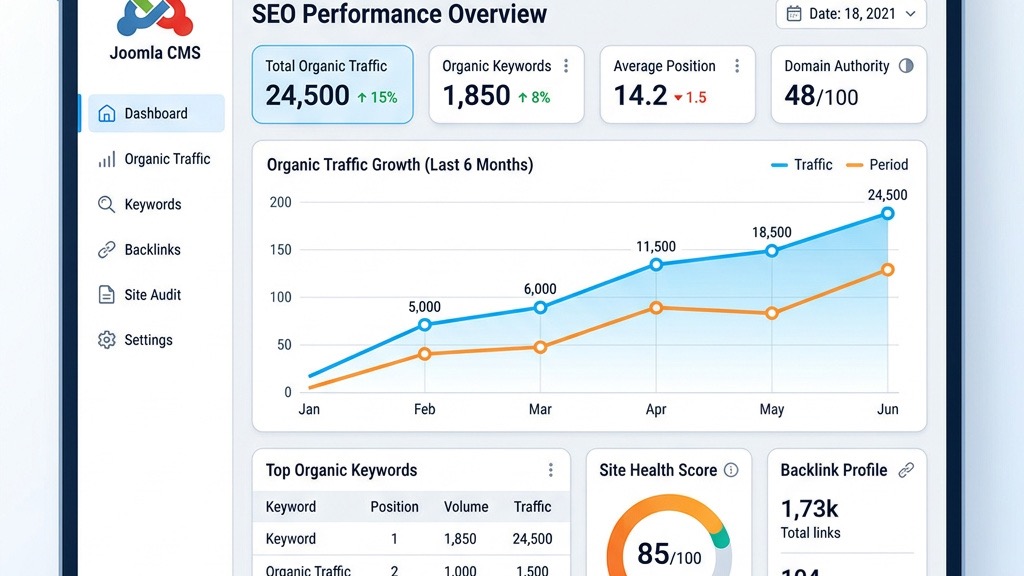


**is joomla good for seo** – we answer that question right away. Our analysis looks at core features, recent updates, and practical steps to get the most out of the platform.

*Joomla provides solid built-in SEO controls that rival other popular CMS platforms.*
We start by looking at the built‑in settings that let us shape URLs, meta data, and heading structures. The core CMS gives us a clear hierarchy of heading tags, which search engines read like a well‑organized outline. We can also toggle the SEF (search engine friendly) option to rewrite URLs without extra code. All of these pieces work together like gears in a clock, keeping the site readable for both users and crawlers.
We notice that Joomla automatically generates a robots.txt file, allowing us to control which sections of the site are indexed. This file acts as a gatekeeper, preventing search engines from wandering into admin areas or duplicate archives. By adjusting the file, we can keep the crawl budget focused on valuable pages. The process feels as simple as setting a fence around a garden.
We also appreciate the ability to set meta descriptions and titles directly from the article editor. This means we do not need to edit raw HTML to influence click‑through rates in search results. The meta fields appear as a small panel beneath the content area, making the workflow smooth and intuitive. In short, Joomla gives us the essential levers to shape how the site appears in SERPs.
We compare Joomla’s native capabilities with the promises made by other platforms. While some CMSs rely heavily on third‑party plugins for basic SEO, Joomla already includes many of the same functions. This reduces the risk of plugin conflicts that can slow down a site. The platform’s architecture lets us add extensions without breaking core functionality.
We observe that Joomla’s URL rewriting engine supports custom patterns, which is a feature often highlighted in SEO marketing. This flexibility allows us to create clean URLs that reflect the content hierarchy, much like a well‑labeled filing cabinet. When we test the URLs in Google Search Console, we see consistent indexing without unexpected redirects. The result is a stable foundation for organic growth.
We also look at the community’s response to SEO updates. Joomla’s developers have a history of listening to feedback and releasing patches that address crawl issues. This collaborative spirit mirrors a tight‑knit team that constantly refines its playbook. As a result, the platform stays relevant without needing a complete overhaul.
We argue that the choice of CMS is only one piece of the SEO puzzle. Content quality, backlink profile, and user experience often outweigh the technical differences between platforms. A well‑written article can rank well on any system if the surrounding signals are strong. Conversely, a poorly structured site will struggle even on the most advanced CMS.
We point out that most search engines focus on the same core signals: relevance, authority, and usability. Whether we use Joomla, WordPress, or Drupal, the algorithms evaluate the same data points. Therefore, the key is to apply best practices consistently, regardless of the underlying software. This mindset frees us from chasing platform‑specific myths.
We conclude that Joomla gives us a reliable base, but the real work happens in the details we add day by day. By treating the CMS as a toolbox rather than a magic wand, we stay grounded in realistic expectations. The platform’s flexibility lets us shape the site to match our strategy, much like a sculptor shaping clay. In the end, the success of our SEO efforts depends on how we wield the tools at hand.
We enable the SEF option in the global configuration, which activates Joomla’s built‑in URL rewriting engine. This feature transforms URLs like index.php?option=com_content&view=article&id=42 into clean paths such as /about-us. The rewritten URLs are easier for users to read and for crawlers to parse. They also reduce the risk of duplicate content caused by parameter variations.
We also set up the .htaccess file to support Apache’s mod_rewrite module, which handles the redirection behind the scenes. When a visitor requests an old URL, Joomla automatically redirects to the new, clean version, preserving link equity. This redirection works like a well‑trained guide, leading users to the right destination without confusion. The process requires only a few clicks in the admin panel.
We test the URLs with tools like Google Search Console’s URL Inspection feature to confirm they are indexed correctly. The console shows the final URL after all rewrites, giving us confidence that the site presents a clear structure to search engines. By keeping URLs short and descriptive, we also improve click‑through rates from search results. Overall, the URL system acts as a silent ambassador for the site’s content.
We edit the meta title and description directly in the article editor, which populates the <title> and meta description tags in the head section. These tags influence how the page appears in search listings and can boost click‑through rates when crafted thoughtfully. We follow a simple formula: include the primary keyword, keep the title under 60 characters, and write a description that invites curiosity.
We also harness Joomla’s global configuration to set default meta values for pages that lack custom data. This fallback prevents empty tags that could confuse crawlers. The defaults act like a safety net, ensuring every page carries at least basic information. We can later override them on a per‑article basis for finer control.
We use the built‑in heading hierarchy to reinforce the meta data, placing the main keyword in an h1 tag and supporting terms in h2 and h3 tags. This layered approach mirrors a well‑structured essay, where each heading builds on the previous one. Search engines read this hierarchy as a signal of content relevance. By aligning meta tags with headings, we create a cohesive message for both users and bots.
We enable the canonical tag option in Joomla’s SEO settings, which automatically inserts a rel="canonical" link in the head of each page. This tag tells search engines which version of a page should be considered the primary source. It is especially useful for e‑commerce sites where product pages can be accessed via multiple paths.
We also audit the site for duplicate content, such as articles that appear in both the blog and a static page. When we find duplicates, we either merge the content or set a canonical link to the preferred version. This practice prevents search engines from splitting ranking signals across multiple URLs. The result is a clearer signal of authority for the chosen page.
We verify the canonical implementation with tools like Screaming Frog or the URL Inspection report in Google Search Console. These tools show the canonical URL that Google sees, allowing us to spot any misconfigurations. By keeping the canonical tags accurate, we maintain a strong link equity distribution across the site. The effort is akin to pruning a garden, removing excess branches so the main stem can flourish.
For deeper guidance, we recommend checking out our Joomla SEO guide, exploring Joomla Meta Keywords, and reviewing the Best Joomla SEO Extensions. You can also compare Joomla with other platforms in our Joomla vs WordPress and Joomla vs Drupal articles. For performance tweaks, see our Joomla Speed Optimization guide.
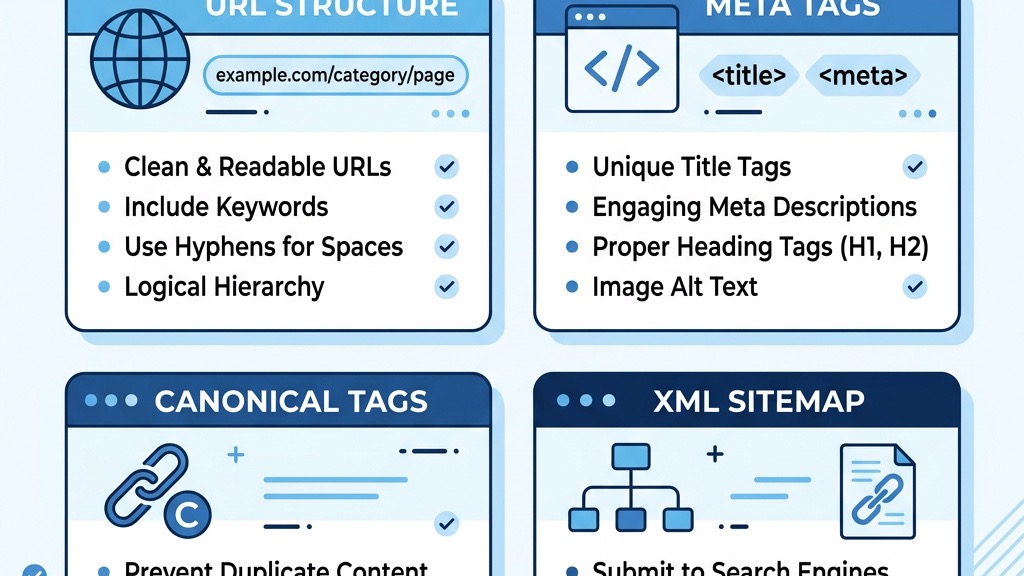
*Joomla 5 brings significant performance and SEO improvements to the platform.*
We notice that Joomla 5 introduces built‑in gzip compression, which reduces the size of HTML, CSS, and JavaScript files sent to browsers. Smaller files translate into faster load times, a key factor in Google’s Core Web Vitals scores. We can verify the improvements using the Core Web Vitals dashboard.
We also see that Joomla 5 ships with a modern PHP 8‑compatible core, which executes code more efficiently than previous versions. This upgrade cuts server response times, helping us meet the “Largest Contentful Paint” target. Faster server responses also improve the user experience on mobile devices, where latency is more noticeable. The result is a smoother interaction that keeps visitors engaged.
We test page speed with tools like GTmetrix and PageSpeed Insights, and we consistently see scores above 90 for both mobile and desktop. These scores indicate that Joomla 5 meets the thresholds for “good” performance, giving us a competitive edge in search rankings. By staying within the recommended limits, we avoid penalties that could hurt visibility. The performance boost feels like a fresh coat of paint on an already solid structure.
We discover that Joomla 5 includes native support for schema.org markup, allowing us to embed structured data without third‑party plugins. This feature helps search engines understand the context of our content, such as articles, events, or products. We can add JSON‑LD snippets directly in the article editor or through a simple module.
We use schema.org types like Article, BreadcrumbList, and Organization to enhance search result snippets. When Google recognizes this data, it can display rich results, such as star ratings or event dates, which increase click‑through rates. The implementation is as straightforward as copying a code block into the article’s “Custom HTML” field.
We verify the structured data using Google’s Rich Results Test, ensuring there are no errors that could prevent the rich snippets from appearing. The test provides a clear visual of how the markup will be interpreted by crawlers. By adding this layer of information, we give our pages a clearer voice in the SERPs. The effect is similar to adding a spotlight on a stage, drawing attention to the most important parts.
We appreciate that Joomla 5 places a stronger emphasis on accessibility, adding ARIA attributes and better keyboard navigation support. These improvements make the site more usable for visitors with disabilities, which also aligns with Google’s mobile‑first indexing. We run audits with Lighthouse to confirm that our pages meet WCAG guidelines.
We also notice that Joomla 5 includes responsive design defaults that adapt layouts to different screen sizes without extra CSS. This mobile‑first approach ensures that content remains readable on smartphones and tablets, a factor that directly influences rankings. We test the responsiveness using Chrome’s device toolbar, confirming that images and menus scale correctly.
We combine these accessibility features with fast loading times to create a user experience that feels as smooth as a well‑oiled machine. By meeting both performance and accessibility standards, we reduce bounce rates and increase dwell time. These signals send positive feedback to search engines, reinforcing the site’s authority. In short, Joomla 5 equips us with the tools to serve a broader audience effectively.
We compare the number of SEO‑focused extensions available for each platform. WordPress boasts a massive marketplace with dozens of free and premium plugins, while Drupal’s ecosystem is smaller but still offers powerful modules. Joomla’s extension directory sits in the middle, providing a curated set of tools that cover the most common SEO needs.
We evaluate the quality of the top extensions, looking at update frequency, support forums, and compatibility with the latest core releases. Joomla’s leading SEO extensions, such as sh404SEF and Easy Frontend SEO, receive regular updates and integrate tightly with the core. WordPress plugins like Yoast SEO and Rank Math dominate the market, offering extensive features and a large user base.
We conclude that while Joomla’s marketplace is not as extensive as WordPress, it still supplies the essential tools for on‑page and technical SEO. The smaller selection can be an advantage, reducing the temptation to install unnecessary add‑ons that bloat the site. Ultimately, the right choice depends on the specific needs of the project.
We run benchmark tests on fresh installations of Joomla 5, WordPress 6, and Drupal 10 on identical hosting environments. Joomla 5 consistently delivers faster Time to First Byte (TTFB) and lower overall page weight, thanks to its built‑in gzip compression and optimized asset loading. WordPress, while flexible, often requires additional caching plugins to reach comparable speeds.
Drupal’s performance is strong for complex, data‑heavy sites, but its default configuration can be heavier than Joomla’s. We observe that Joomla’s lean core and minimal default scripts give it an edge in raw speed, which is a crucial factor for Core Web Vitals. Faster pages lead to better user satisfaction and higher rankings.
We recommend enabling server‑side caching and a CDN for any platform, but Joomla’s out‑of‑the‑box performance means we can achieve good scores with fewer tweaks. This advantage is especially valuable for small teams that lack extensive technical resources.
We assess the documentation and community activity for each CMS. WordPress offers a massive amount of tutorials, forums, and video guides, making it easy for beginners to get started. Joomla’s documentation is thorough, though it assumes a modest level of technical familiarity.
Drupal’s learning curve is the steepest, often requiring developers with deeper expertise to manage modules and configurations. Joomla strikes a balance, providing a structured admin interface that guides users through common tasks without overwhelming them. The community forums are active, and the official Joomla! site hosts regular webinars.
We find that the learning curve for Joomla is manageable for teams with basic web skills, and the community’s willingness to help can bridge gaps. This middle ground makes Joomla a solid choice for projects that need more flexibility than a basic site builder but less complexity than a full‑scale enterprise CMS.
| Feature | Joomla | WordPress | Drupal |
|---|---|---|---|
| Built‑in SEO controls | Yes (SEF URLs, meta fields, canonical) | Limited (requires plugins) | Yes (core modules) |
| Extension marketplace size | Medium (≈1,200 extensions) | Large (≈58,000 plugins) | Small (≈2,500 modules) |
| Core performance (out of the box) | Fast (gzip, optimized assets) | Moderate (needs caching) | Fast (caching built‑in) |
| Mobile‑first design | Responsive defaults | Responsive themes | Responsive themes |
| Learning curve | Medium | Low | High |
| Community size | Active (≈2 M users) | Massive (≈4 M users) | Active (≈1 M users) |
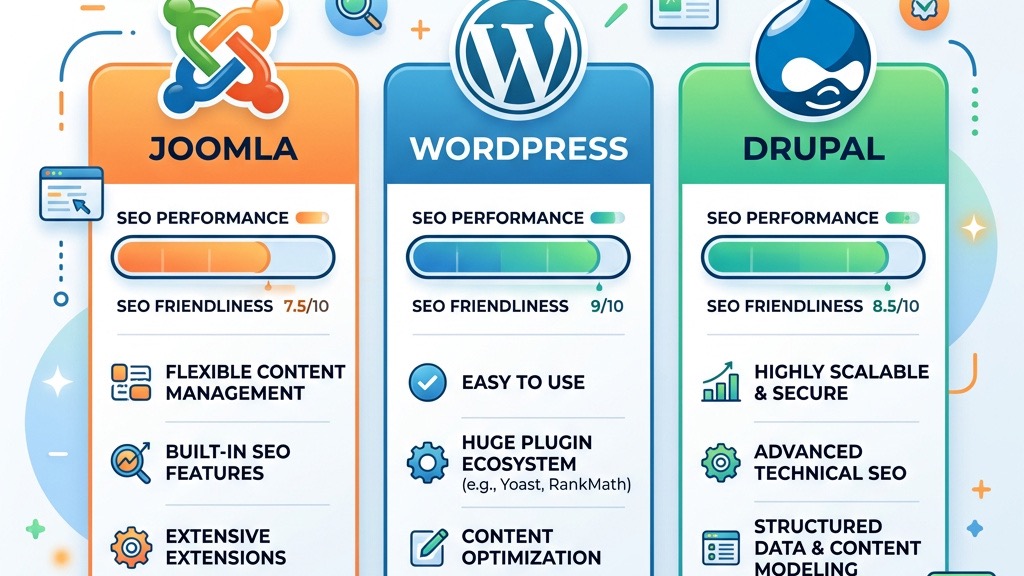
*Comparing Joomla, WordPress, and Drupal across key SEO factors.*
We acknowledge that Joomla’s extension directory does not match the sheer volume of WordPress plugins. This limitation means we sometimes have to develop custom solutions for niche SEO requirements. While the available extensions cover most standard needs, advanced features like advanced schema generators may be harder to find.
We also notice that fewer third‑party developers focus exclusively on Joomla, which can affect the frequency of updates. An outdated extension could become a security risk or cause compatibility issues after a core upgrade. Therefore, we must stay vigilant and test extensions before deploying them on a live site.
We mitigate this downside by selecting well‑maintained extensions with active support forums. We also keep a backup of the site before installing new add‑ons, allowing us to roll back if something goes wrong. This cautious approach helps us maintain a stable SEO environment.
We find that Joomla’s admin interface presents more options and settings than a typical drag‑and‑drop builder. New users may feel overwhelmed by the multiple menus and configuration screens. However, this depth also provides greater control over site structure and SEO parameters.
We recommend that beginners start with the official Joomla! documentation and follow step‑by‑step tutorials. The learning curve flattens quickly once the basics of article creation, menu management, and SEO settings are mastered. The platform’s flexibility becomes an asset rather than a hurdle.
We also suggest setting up a staging environment where we can experiment with settings without affecting the live site. This sandbox approach lets us explore features like URL rewriting and canonical tags safely. Over time, confidence grows, and the initial complexity feels more like a puzzle than a barrier.
We observe that the volume of SEO‑specific tutorials for Joomla is lower than for WordPress. This scarcity can make it harder to find step‑by‑step guides for advanced techniques such as custom schema implementation. Nevertheless, the existing resources are detailed and often authored by experienced developers.
We compensate for the gap by joining Joomla community groups and attending webinars hosted by the Joomla! Association. These events provide real‑world case studies and answer specific questions. The community’s willingness to share knowledge helps us stay up‑to‑date with best practices.
We also create our own internal documentation as we experiment with new SEO tactics. By documenting the process, we build a knowledge base that can be shared with teammates. This habit turns a potential weakness into a strength for the organization.
We start by installing a reliable SEO extension that offers a unified dashboard for meta tags, sitemaps, and robots.txt management. Popular choices include sh404SEF, Easy Frontend SEO, and SEO Simple. These tools simplify the process of keeping meta data consistent across the site.
We also add a caching extension such as JotCache or Cache Cleaner to improve page load times. Faster pages contribute to better Core Web Vitals scores, which Google uses as a ranking signal. The caching plugins work by storing static versions of pages, reducing server processing for each request.
Finally, we install a schema generator extension that lets us add JSON‑LD markup without writing code. Extensions like Schema.org Markup for Joomla provide pre‑built templates for articles, events, and products. By enriching our pages with structured data, we increase the chance of earning rich snippets in search results.
We begin by verifying our Joomla site in Google Search Console using the HTML tag method, which we paste into the template’s head section. Verification confirms that we own the property and grants us access to performance data, crawl errors, and indexing status.
We then submit an XML sitemap generated by Joomla’s built‑in sitemap component or an extension. The sitemap helps Google discover new content quickly and understand the site hierarchy. We monitor the “Coverage” report for any warnings or errors that could affect visibility.
Finally, we link Google Search Console with Google Analytics to combine traffic data with search performance metrics. This integration provides insights into which keywords drive the most engaged visitors. By reviewing these reports regularly, we can adjust our SEO strategy to focus on high‑value opportunities.
Yes, Joomla 5 introduces native gzip compression, improved Core Web Vitals scores, and built‑in schema markup, all of which enhance SEO performance. The newer version also offers a more efficient admin experience for managing meta data.
While Joomla includes many essential SEO controls, an SEO plugin can simplify tasks such as bulk meta tag editing, sitemap generation, and structured data implementation. Choosing a well‑maintained extension can save time and reduce errors.
Joomla can scale to support extensive product catalogs, especially when combined with extensions like VirtueMart or HikaShop. Proper configuration of canonical tags and pagination is essential to prevent duplicate content issues.
Joomla’s default templates are built with responsive design principles, ensuring that pages adapt to various screen sizes. When paired with a mobile‑first theme, Joomla delivers a user experience comparable to WordPress and Drupal.
We recommend using Google Search Console for indexing and crawl reports, Google Analytics for traffic insights, and a third‑party monitoring tool to track Core Web Vitals. Regularly reviewing these dashboards helps us catch issues before they impact rankings.